
The Screenshot Economy: Why Your Business Is Running on Evidence Nobody Can Find

A customer sends a screenshot of a payment.
A team member shares a screenshot of a website error.
Someone saves a screenshot of an important conversation.
Another employee takes a screenshot of a spreadsheet because explaining the numbers would take too long.
Then, three weeks later, somebody asks a surprisingly difficult question:
“Where did we save that screenshot?”
Welcome to the screenshot economy.
Modern businesses have more digital tools than ever. They use websites, cloud storage, messaging platforms, spreadsheets, CRMs, project management software and AI assistants.
Yet important business information still travels through screenshots, copied messages, downloaded files and browser tabs that nobody remembers opening.
The strange part?
Everything appears to be digital.
But finding the right information can still feel like searching through a filing cabinet in a dark room.
The Screenshot Is a Symptom, Not the Problem
Screenshots are useful. They provide visual evidence, capture temporary information and make complex situations easier to explain.
The problem begins when a screenshot becomes the final destination for information that should have a proper home.
Consider a typical business scenario.
A customer reports a problem with their website. An employee captures the issue and sends it to a colleague through a messaging app.
The colleague forwards it to a developer.
The developer fixes the problem and sends another screenshot.
The original employee then forwards the updated image to the customer.
Everything appears to work.
But where is the actual record of the issue? Who owns the task? Was the problem resolved? Can another employee find the solution six months later?
If the answers depend on searching through personal conversations, the business has a knowledge management problem.
It does not necessarily need another app.
It needs a better way to move information from one person to the next.
Your Business Is Producing Digital Evidence Every Day
Think about how much information your business creates in a single week.
-
Customer enquiries arrive through website forms.
-
Sales conversations happen through email and messaging platforms.
-
Marketing teams capture campaign results.
-
Developers document bugs and technical changes.
-
Employees share project updates.
-
Customers send files, screenshots and supporting documents.
-
Managers make decisions during meetings.
-
AI tools generate summaries, drafts and recommendations.
Every interaction can produce useful information.
But information only becomes valuable when people can find it, understand it and act on it.
A screenshot in an employee's downloads folder might contain the answer to a customer question. A conversation buried in an inbox might explain why a project changed direction. A spreadsheet might contain the latest figures, while a different spreadsheet contains last month's version.
The business technically possesses the information.
Operationally, however, that information might as well be missing.
This is the difference between having data and having usable knowledge.
The Hidden Cost of “I'll Send It to You Later”
Most information problems do not begin with a major technical failure.
They begin with small decisions.
“I'll email it later.”
“I'll save it on my desktop.”
“I'll put it in the spreadsheet.”
“I'll send you the screenshot.”
“I'll remember to follow up.”
Individually, these decisions seem harmless.
Multiply them across an entire team, and they create a business that depends heavily on memory, manual effort and individual workarounds.
Consider a hypothetical business with ten employees. If each person spends just 15 minutes per working day searching for information, clarifying details or recreating work, the business loses 12.5 staff-hours every week.
That is more than 50 hours over four working weeks.
This is an illustrative calculation, not an industry benchmark. Your actual cost will depend on your team and processes.
The larger point is that repeated small delays can consume a meaningful amount of working time without appearing as a separate expense on a financial report.
You may never see a line item called “Searching for the Latest Screenshot”.
But somebody is paying for it.
When Your Website Becomes Another Information Island
The problem often starts at the front door of a business: its website.
A potential customer visits your website, reads about your services and submits an enquiry.
The form sends an email.
Someone copies the details into a spreadsheet.
Another employee creates a customer record.
A sales representative schedules a follow-up.
If the prospect becomes a customer, documents are exchanged and a project begins.
At every stage, information moves between systems.
If those systems are poorly connected, employees become the integration layer.
They copy and paste details, forward messages, rename files, explain context and manually update records.
This works until the workload grows, someone makes a mistake or the person who understands the process is unavailable.
A well-designed website should do more than attract attention. It should fit into a broader digital journey that makes it easier to capture, manage and use information.
That may involve website development, CRM integration, application development or workflow improvements. The right solution depends on where information gets lost.
The objective is not to automate everything.
It is to remove unnecessary work between one meaningful action and the next.
Your CRM Should Remember What Your Inbox Cannot
An inbox is excellent for communication.
It is not necessarily the best place to manage the complete history of a customer relationship.
Imagine that a customer contacts your business, receives a proposal, asks for a revision and returns several weeks later.
If the conversation is scattered across emails, attachments and personal notes, your team must reconstruct the relationship before it can continue.
A customer relationship management system, or CRM, gives that relationship a more structured home.
Instead of relying entirely on individual memory, a business can maintain customer records, track opportunities, document interactions and organise follow-up activities.
The important distinction is that a CRM should not simply become another database that employees forget to update.
It should support the actual way your business works.
For businesses looking to improve this process, SalesIntellect CRM can be part of a more organised approach to managing leads and customer relationships.
The goal is simple: when a customer returns, your team should have a better chance of continuing the conversation instead of starting the investigation again.
The Same Problem Exists With Files and Internal Workflows
Customer information is only one part of the picture.
Projects generate their own digital evidence.
A designer creates a draft. A manager requests changes. A developer uploads a revision. A client approves a final version.
If those files and decisions are scattered across email attachments, messaging apps and personal folders, the team may struggle to identify the current version or understand why a decision was made.
This is where structured file management and collaboration become important.
A shared environment can help teams organise documents, maintain access to relevant information and reduce the need to repeatedly send the same files.
Likewise, clear workflows can help establish who is responsible for the next action and whether a task is complete.
Intellecta's Share and Engage products are relevant to this broader challenge of organising information, files and collaboration across business activities.
The underlying principle is more important than any particular tool:
Information should follow the work, not disappear into someone's private collection of screenshots.
AI Cannot Magically Fix Information Chaos
There is a tempting solution to all this.
Add AI.
Ask an AI assistant to search documents, summarise conversations, find customer details and automate repetitive work.
These capabilities can be useful. But they depend on the quality, accessibility and context of the information being used.
If the latest proposal is buried in an unlabelled folder, the customer record is incomplete and the project decision exists only in a private chat, adding AI does not automatically solve the underlying problem.
It may simply make an inconsistent process faster—or introduce new errors if it retrieves outdated or incomplete information.
Before introducing sophisticated automation, businesses should establish a few foundations:
-
Important information has an identifiable home.
-
Records have clear ownership.
-
Teams know which version is authoritative.
-
Access permissions reflect business needs.
-
Repetitive processes have clear rules.
-
Automated actions can be checked when something goes wrong.
AI works best as part of a well-designed process, not as a substitute for one.
What About the Screenshots Coming Through Your Website?
There is another overlooked category of digital information: the messages businesses receive from the outside world.
Contact forms can collect genuine enquiries, support requests, partnership proposals and other useful information.
They can also attract automated submissions, irrelevant pitches and spam.
When everything arrives in the same inbox, employees must spend time identifying which messages deserve attention.
That is another form of information friction.
SpamForms is designed to help businesses distinguish unwanted contact-form submissions from genuine enquiries, helping reduce the noise that can obscure useful opportunities.
You can learn more at SpamForms.
The broader lesson is that collecting information is only the first step. Businesses also need a sensible way to assess, organise and route it.
A Five-Day Experiment to Find Your Information Gaps
You do not need to replace your entire technology stack to begin improving things.
Start with a small experiment.
Day 1: Follow one customer enquiry.
Trace the journey from the original website submission to the latest interaction. Record every place the information travels.
Day 2: Find the repeated work.
Look for details that employees copy manually, files that are repeatedly sent or questions that require someone to search through old conversations.
Day 3: Identify the source of truth.
For each important record, decide where the authoritative version should live. Avoid creating another duplicate repository without a clear purpose.
Day 4: Fix one broken handover.
Choose a single process, such as routing a website enquiry to the right person or making the latest project document easier to find.
Improve that process before attempting a company-wide transformation.
Day 5: Measure the difference.
Compare how long the task takes, how many manual steps it requires and whether the next person can continue the work without asking for missing context.
The purpose is not to eliminate screenshots.
It is to discover where your business is using screenshots, memory and manual effort to compensate for a broken process.
The Real Competitive Advantage Is Not More Software
Businesses often compete by adding more technology.
More platforms. More dashboards. More integrations. More AI features.
But a larger technology stack does not automatically create a better business.
Sometimes, the advantage comes from making the existing systems work together more effectively.
A customer enquiry reaches the right person. A sales conversation has a clear history. A project document is easy to find. A team member knows the next action. A useful piece of information does not disappear when someone leaves the company.
These improvements may not look impressive in a technology demonstration.
They can make a meaningful difference to the way a business operates.
At Intellecta, the opportunity is to look beyond individual digital tools and consider how websites, applications, SEO, customer management and internal workflows support the wider business.
Because the ultimate goal of technology is not to give people more places to store information.
It is to help them do something useful with it.
Your Next Business Asset Might Already Exist
It might be in an email.
A spreadsheet.
A customer record.
A project folder.
Or a screenshot someone saved three months ago.
The information is already there. The opportunity is to make it accessible, reliable and useful when it matters.
So the next time someone in your business says, “I know I saved that somewhere,” consider it more than a minor inconvenience.
It might be a sign that your digital systems need to work together better.
Your business does not need to remember everything. It needs a reliable way to find what matters.
And that is a much better starting point for digital transformation.
More articles

Your Website Has a Memory: What Does It Remember About Your Customers?
Your website sees more than clicks and form submissions. Discover how connecting your website with forms, CRM, workflows and customer data can help your business remember, manage and act on every opportunity.
Read article →
CRM vs Spreadsheet: When Should Your Business Make the Switch?
Not sure when it's time to replace your spreadsheet with a CRM? Learn the practical signs that your sales process has outgrown spreadsheets and how to make the switch without disrupting your team.
Read article →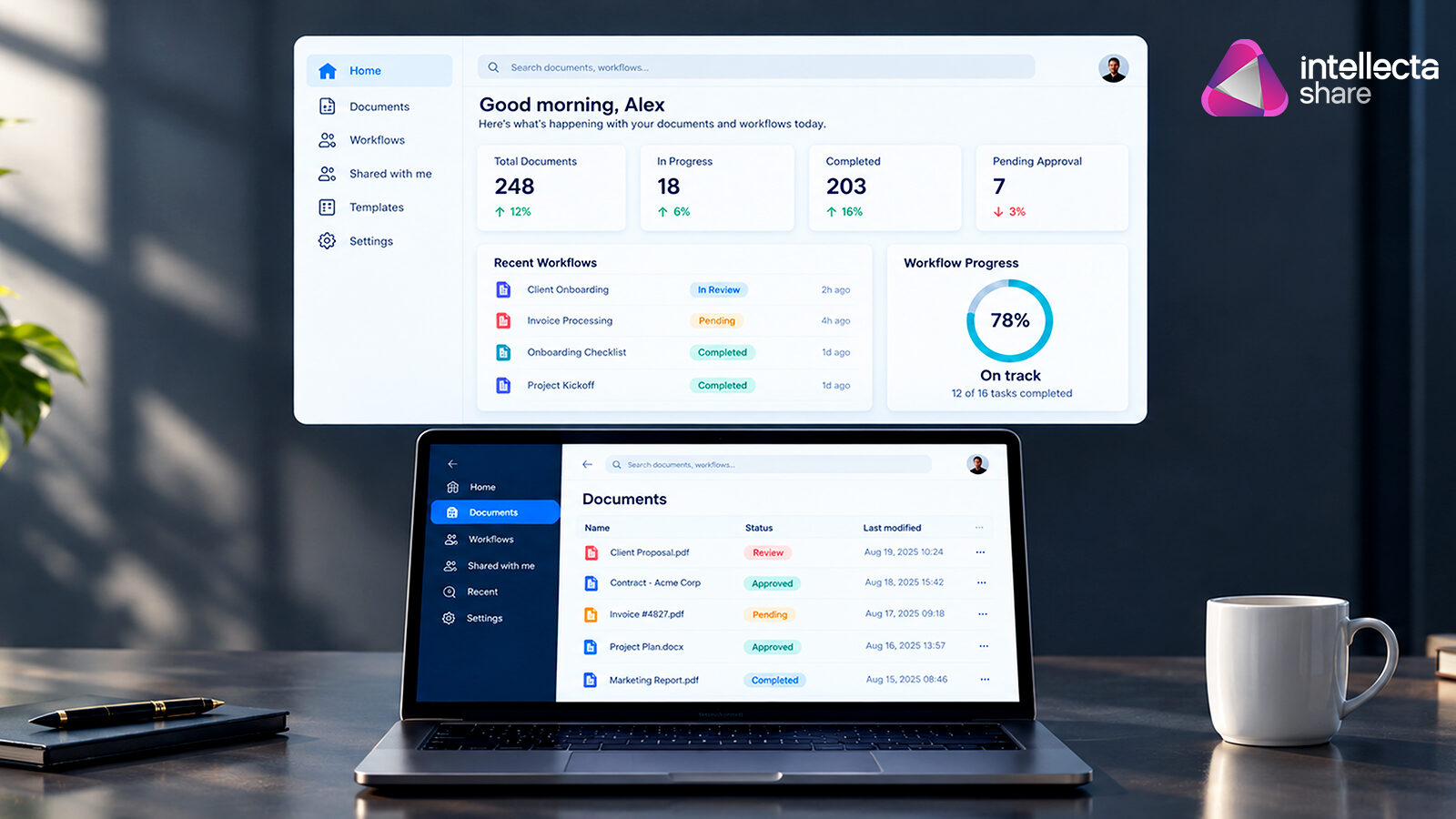
Beyond File Sharing: How Modern Businesses Are Turning Documents Into Workflows
File sharing is easy. Managing everything that happens around those files is much harder. Discover how modern document workflows combine file management, collaboration, automation, and AI to help businesses turn documents into actionable processes.
Read article →